
Wine Bottles & Terra Cotta Stakes: Keeping your Garden Hydrated
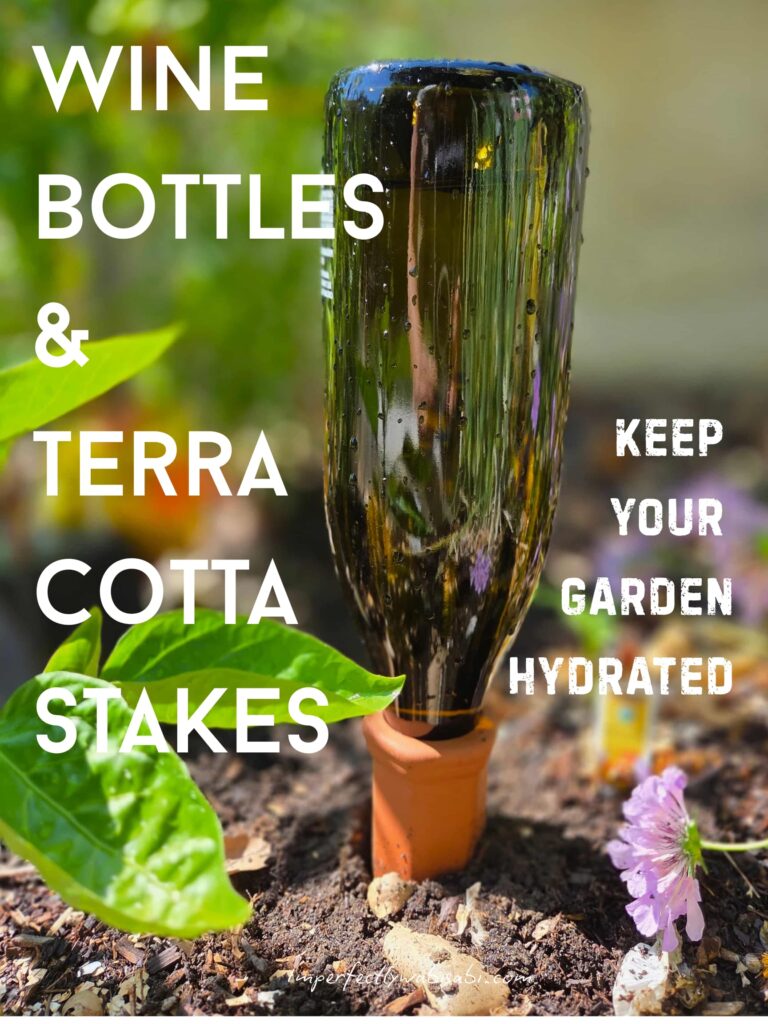
Summer months can spell heat waves, drought, parched soils, and wilted, crispy leaves for your garden. Luckily, sustainable solutions that don’t require much in costs or maintenance exist. In fact, some of the materials are likely sitting inside your recycle bin right now. If you’re the kind of gardener who takes delight in the occasional wine or bubbly, you’ve practically got all the materials at-hand already.
Go head. Go on vacation.
Terra cotta stakes are a quick, simple way to keep your garden hydrated in the summer heat, especially if you’re about to head out on vacation. It won’t cost much in upfront or long-term maintenance costs, and it won’t even create that much disturbance for your soil ecosystem.
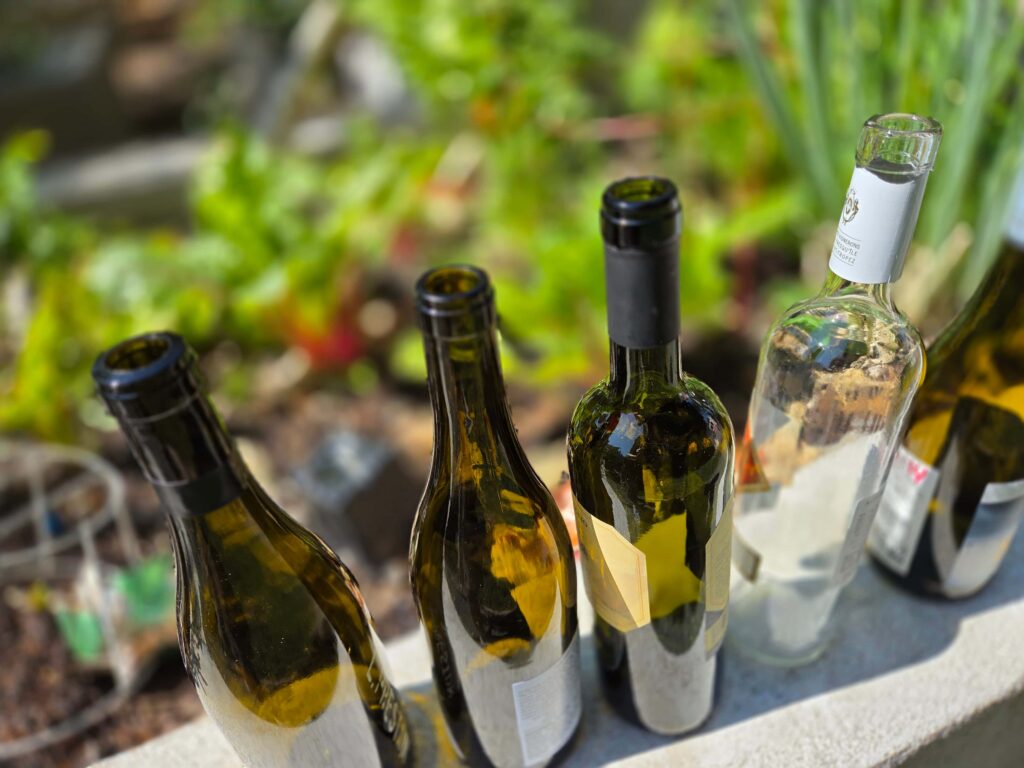
Plus, it’s a great way to re-purpose those empty wine bottles. Save those wine bottles after a gathering or a cozy night in. Or here’s a hot tip: Call your local winery or restaurant bar. They’re usually loaded with empty bottles destined for recycle bins anyway. You’d be surprised with how willing they are to share their empty wine bottles and corks.
Hot Tip:
Need a bunch of empty wine bottles in a jiffy? Call your local winery or restaurant bar. They’re usually loaded with empty bottles destined for recycle bins, anyway. You’d be surprised with how willing they are to share their empty wine bottles and corks!
Give your Garden an Extra Hydration Boost
What is Terra Cotta? What’s the difference between Terra Cotta and Clay?
Terra cotta is a type of baked clay with a higher iron oxide and lower lime content (Reddy, Chenna 2023). Iron oxide melts at a lower temperature, allowing terra cotta to be baked at a lower temperature than clay, which creates the porosity profile of terra cotta to develop. How? Well, turns out that baking in a lower temperature means that not all elements will melt, leaving some gaps, or pores, behind in the baking process (Soul Ceramics).
Terra Cotta, Clay, & Water Efficiency
Terra cotta and clay vessels have been keeping gardens irrigated for thousands of years. Take the Olla irrigation system, one of the oldest and most efficient indigenous methods of irrigation, with its origins in Asia and the Middle East (Bainbridge 2001). Ollas are clay vessels or pots filled with water buried into the soil alongside plants whose roots get hydrated when the surrounding soil conditions become too dry. The porosity of the clay creates a self-regulating system for irrigation based on soil moisture levels and plant hydration needs (Mashizi and Khakpour 2025).
Studies have shown that water consumption through the application of the olla method can be reduced by 50% compared to conventional irrigation methods. In growing food, the olla method has also been shown to support stronger root development and healthier crop yields in melon farming, mint cultivation, and pistachio plantations with minimal water waste (Mashizi and Khakpour 2025).
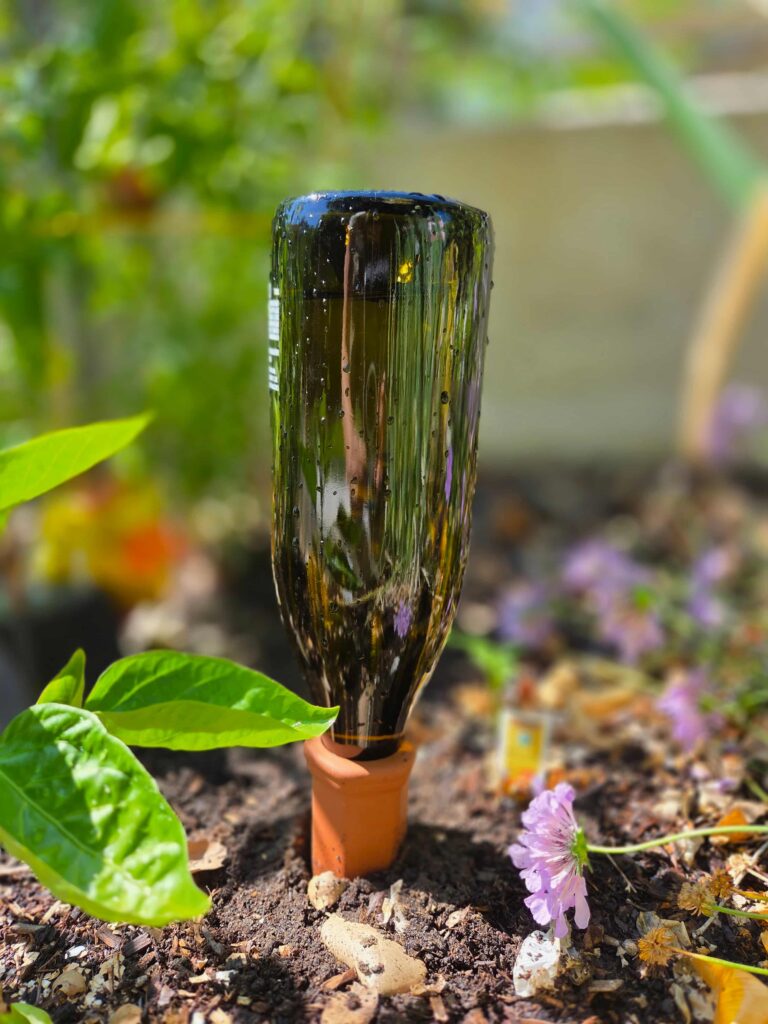
The other form of using clay or terra cotta in the garden is through staking. Terra cotta stakes provide irrigation services to the garden as well, but in the inverse of how the olla method does it. While the Olla method irrigates through its below-ground water reservoir, terra cotta stakes have their water reservoir above-surface, mainly contained in wine bottles.
How does the Terra Cotta Stake Work?
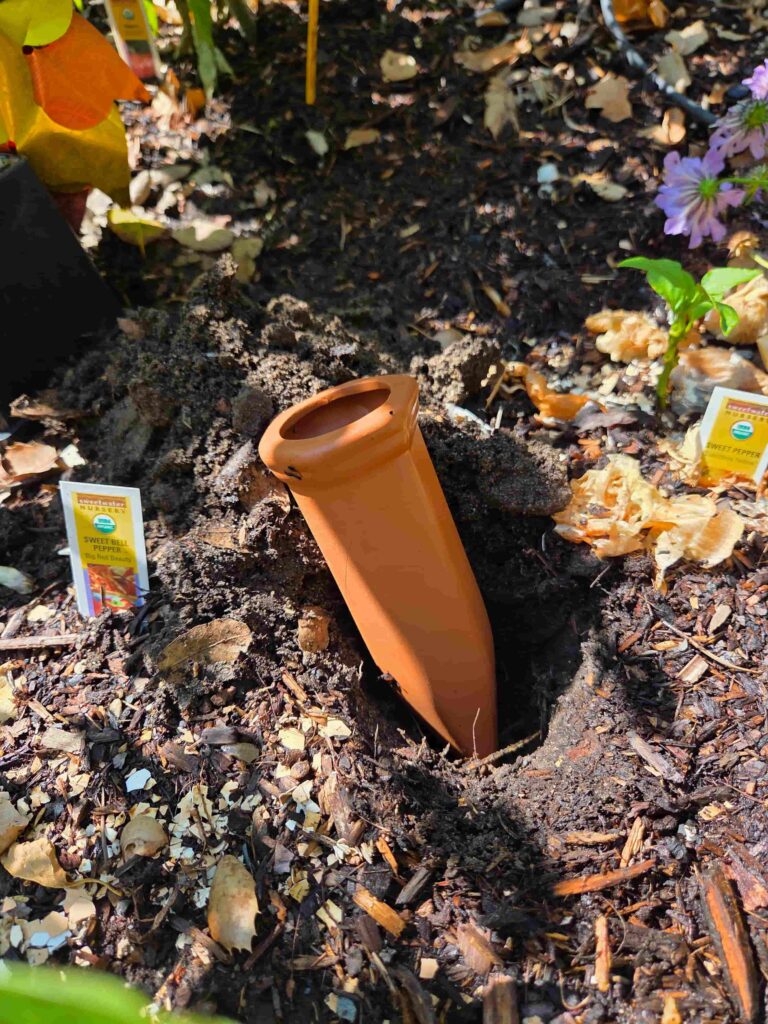
Terra Cotta stakes are made up primarily of terra cotta, a naturally porous clay material, which allows for the slow release of water to the surrounding soil region and plant roots within a certain radius.
Like the ollas, terra cotta stakes release water when the soil around them is dry (i.e., upon demand), making them an ideal low-cost, low-maintenance, yet efficient method for keeping a garden alive while you’re away, or if you simply want to make sure your plants are getting enough water without overwatering and wasting water.
Why Use Terra Cotta Stakes?
Sometimes, you gotta go away for a few days, or a week. Sometimes in a split second notice. Sometimes watering once a day isn’t enough, but twice a day is excessive.
Terra cotta stakes are super quick and easy to use. There’s no need for elaborate irrigation tubing and timer set-ups. A bottle of wine will keep your garden bed hydrated for about a week, depending on weather conditions and how hot it is outside.
It’s a great way to re-purpose those empty wine bottles after thoroughly enjoying their contents combined with the water efficiency properties of the terra cotta.
There’s really no additional construction or labor involved past digging a hole as deep as the length of the terra cotta stake and filling those empty wine bottles with water. No further assembly required.
Environmental Benefits of Keeping your Garden Hydrated Through Terra Cotta Stakes
- Decreased surface runoff, reducing excess water consumption and mitigating the potential for weed growth
- Reduced water consumption due to more targeted watering to the root zone of plants and terra cotta’s naturally efficient water retention and release system
- Minimal leaching of microplastics (BPA, phthalates, etc.) into the soil where you grow your food due to the material requirements of only terra cotta and glass
- Easy set-up and maintenance that is low-cost and low-maintenance – glass won’t melt under the sun (even in heat waves) and in-ground stakes are unlikely to crack due to high temperatures as well. And when the terra cotta do break (nothing lasts forever), they naturally break down over time without leaching chemicals and microplastics into the soil.
- Partake in zero-waste by re-purposing used materials/wine bottles for the garden
- Minimal soil disturbance – just dig the hole once and keep the stakes in there. Refilling with water takes place above-surface.
Glass and clay are among the more sustainable materials to use when gardening. Unlike plastic and its broken down entourage of microplastics, glass and clay don’t have many pollutants or chemicals to leach into the soil. According to this study, the presence of terrestrial microplastic pollution is estimated to be up to 23 times higher than in marine ecosystems. Phthalates and BPA, in particular, leach out of plastics and disrupt hormone levels of not just humans but of soil invertebrates as well. Glass, on the other hand, is mainly made up of silica, a natural and non-toxic material. While the overall sustainability of these materials depends on how they are sourced, produced, processed, and transported, and how they ultimately break down, the impact on soil and water contamination remains clear. Glass and clay are the more sustainable garden options.
Fun Fact:
In addition to its practical applications in the garden, clay pots serve an important role in drinking water storage. A study conducted in 2024 concluded that clay pots were shown to reduce microbial contamination, reduce levels of total dissolved solids (TDS), and provide higher water quality than plastic containers (Ibrahim et al. 2024).
Terra Cotta pots are also a more sustainable option than plastic containers, as clay breaks down naturally without polluting the soil or water. In many countries where water sanitation facilities are limited, clay pots serve as a cost-effective alternative to plastic bottles and tanks for drinking water storage (Ibrahim et al. 2024).
How to use Terra Cotta Stakes in the Garden
Here are the stakes that I purchased. You can find some great options online or at your local nursery. There’s really no significant difference in product. The main thing to look for is quantity, which will depend on your garden size and needs.
How many to purchase depends on watering needs, garden size, and number of pots. For a medium-large garden bed size, consider selecting a 12-pack.
Identify the placement of each garden stake before you start digging. Planning it out helps to maximize the distribution of the irrigation from these stakes. Look for places near but not right beside plants, about 6 inches away, and ideally in places where several plants’ roots would be within radius of the terra cotta stakes.
In just a few simple steps
- Once you’ve identified and mapped out where the stakes would go, start digging. Dig a stake-length and stake-wide hole where the stake would be placed. Try to get the entire stake in there to maximize water surface exposure to the soil, but it’s okay if it sticks out by an inch or so.
- Place the stake in. Make sure it’s snug and upright.
- Fill your wine bottles, top ‘em off with water.
- And then in one fell swoop, gently dunk them into each of the stakes. (The stakes will break if you pound them in).
- Cheers! Enjoy your vacation knowing your plants are getting hydrated.
Maintenance and Long-Term Care
Terra cotta stakes are easy to maintain. For the most part, just leave the stakes in the soil (the less soil ecosystem disturbance, the better). But over time, mineral build-up through the water will occur and decrease the porosity of the clay walls, so take the stakes out once in a while (right after the last frost, is when I do my spring cleaning to give them a quick clean) and give the inside of the stakes a quick scrub with a toothbrush or simply give it a quick spray on the inside with a high-pressure, projectile-based setting with the hose to clean out any mineral accumulation.
Simple, Efficient, and Upcycled
Think of this as the trifecta irrigation method for the wine and upcycling-loving gardener. Reducing waste and re-purposing those emptied wine bottles for the garden? Why not?
So, why not?
Keep your garden hydrated. Keep those veggies and flowers alive while you take off for the week. And do so in a way that requires minimal effort that also reduces waste by upcycling materials you’ve already got lying around.
Curious for more sustainable and regenerative gardening ideas? Check out what's In the Garden!


Wabi Sabi. Imperfectly Wabi Sabi.
Growing food is its own form of peace and act of rebellion.
At Imperfectly Wabi Sabi, our garden is an ecosystem. We grow our food using regenerative, zero-waste, and sustainable practices, by putting soil health at the heart and center of everything we grow — no pesticides ever; just good compost (i.e., food scraps from the kitchen), worm poop, and with help from nature and our critter neighbors.
It’s a garden-to-kitchen, regenerative way of life here.

Share this with others!
Hey! Did you know that our website is Green?


You May Also Like

Growing Passionfruit at Home: The Garden to Table Guide
April 15, 2026
5 Surprising Uses for All Those Lemons
February 11, 2026